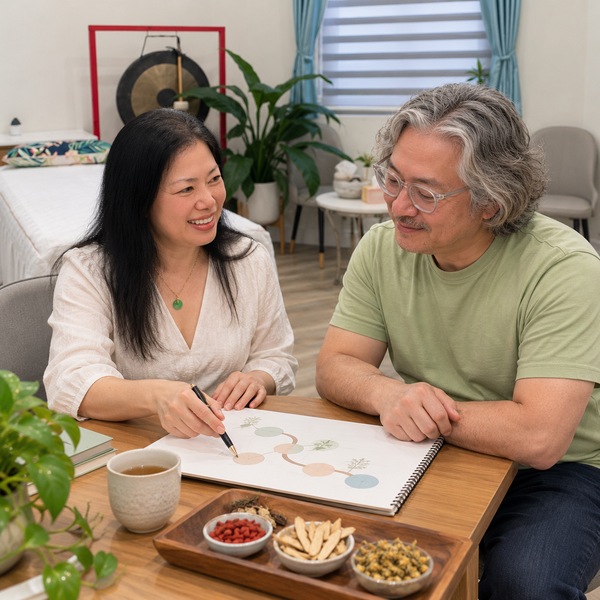
The Lane Cove rooms are at 2 Austin Street, directly opposite the Lane Cove Library and a few metres from Longueville Road. If you are coming from the village it is a walk of two or three minutes, and the parking behind the library is the easiest option in the middle of the day.
Lane Cove sends a particular mix of problems through the door. There are the desk-and-commute necks and low backs from St Leonards and the city, the shoulders and elbows of a suburb that plays a lot of tennis, and the knees and Achilles tendons that come with living on a hillside — the stairs down to Tambourine Bay and the streets off Burns Bay Road are their own kind of training load. Lane Cove also has a lot of people in their thirties and forties carrying small children, which is its own demand on a back.
A first appointment is mostly questions and movement testing: where the pain is, what makes it worse, what it stops you doing, and how it has behaved over weeks rather than days. From there you should leave knowing what is proposed, roughly how long it is expected to take, and what would mean changing the plan.
Worth bringing: any imaging or specialist letters you already have, a list of medications, and the shoes you actually walk or train in. If the pain is new and severe, follows a significant fall, or comes with numbness, weakness, fever or any change in bladder or bowel control, see a doctor first — that is a medical assessment, not a treatment question.
The nearest alternative if Lane Cove does not suit you is the Freshwater side, about 14 kilometres away across the Spit.

Everyday nerves are normal, but worry that keeps disrupting sleep, work or movement is worth talking about. Here is how to start, with or without the right words.
Nerves before a job interview or a medical test are part of ordinary life. It is a different matter when worry returns night after night, makes you call in sick, or keeps you from the walk or class you used to enjoy. For people already managing aches and stiffness, anxiety can also tangle with physical symptoms, making it hard to tell which is which.
A racing heart, a tight chest, stomach upset or muscle tension may be linked with anxiety, but they should not be written off as nerves without a proper look. Your GP can assess physical symptoms, particularly new or changing ones, so that nothing important is missed.
Dr Christine Shen, Acupuncturist, also holds qualifications in psychotherapy and offers psychological treatment at the Freshwater clinic. You do not need to arrive with a diagnosis or the right vocabulary. Concrete examples tend to be more useful:
From there, Christine can talk with you about what has become harder, what kind of psychological support might suit, and whether a further medical assessment would be sensible alongside it.
Your priorities belong at the centre. You might want to understand why certain situations set off worry, or to feel steadier when pain flares and your mind races ahead. Ask how progress will be noticed, how often the approach will be reviewed, and who to contact if things become more difficult between appointments.
If anxiety feels overwhelming or you are worried about your safety, contact your GP, a crisis line or emergency services straight away rather than waiting for a booked session.
Starting with one honest example is enough. The rest of the picture can be filled in gradually, at a pace that feels manageable for you.
Copyright© 2002-2026 visuallink© SaaS - Web Hosted Solutions, Design and Maintenance by Visual Link IT Pty Ltd - Software Solutions

Please Login or Sign up to be able to comment