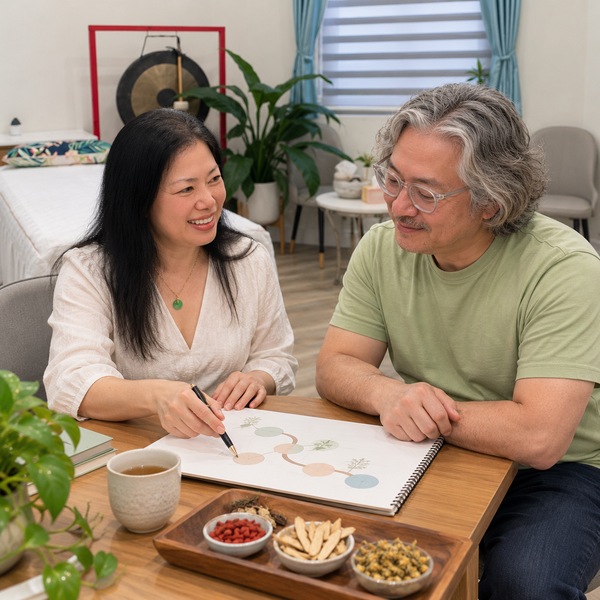
The Lane Cove rooms are at 2 Austin Street, directly opposite the Lane Cove Library and a few metres from Longueville Road. If you are coming from the village it is a walk of two or three minutes, and the parking behind the library is the easiest option in the middle of the day.
Lane Cove sends a particular mix of problems through the door. There are the desk-and-commute necks and low backs from St Leonards and the city, the shoulders and elbows of a suburb that plays a lot of tennis, and the knees and Achilles tendons that come with living on a hillside — the stairs down to Tambourine Bay and the streets off Burns Bay Road are their own kind of training load. Lane Cove also has a lot of people in their thirties and forties carrying small children, which is its own demand on a back.
A first appointment is mostly questions and movement testing: where the pain is, what makes it worse, what it stops you doing, and how it has behaved over weeks rather than days. From there you should leave knowing what is proposed, roughly how long it is expected to take, and what would mean changing the plan.
Worth bringing: any imaging or specialist letters you already have, a list of medications, and the shoes you actually walk or train in. If the pain is new and severe, follows a significant fall, or comes with numbness, weakness, fever or any change in bladder or bowel control, see a doctor first — that is a medical assessment, not a treatment question.
The nearest alternative if Lane Cove does not suit you is the Freshwater side, about 14 kilometres away across the Spit.

Moxibustion can involve sticks, cones or materials placed between the moxa and the skin. Each is a different application, and none is a menu for experimenting at home.
Look up moxibustion and you will see several quite different pictures: a glowing stick held above the skin, small cones resting on the body, or moxa sitting on a slice of ginger or another layer. These are distinct applications with their own precautions. They are not a set of options to try out at home on a stiff knee or a cold lower back.
In broad terms, moxibustion may be:
Each method delivers heat differently and carries different considerations for skin contact, smoke and comfort.
Knowing the word moxibustion is not the same as knowing what will happen. When you see Dr Christine Shen, Acupuncturist, at the Freshwater clinic, ask exactly which technique is being considered, whether it is direct or indirect, and what precautions apply in your case. Clarify which sensations mean you should speak up immediately, such as sharp heat or stinging.
Your own circumstances matter here. Reduced sensation from diabetes or nerve problems, fragile skin, recent sunburn and breathing conditions that react to smoke can all change which method suits you, or whether moxibustion is appropriate at all.
Agree on how you will let Christine know when the heat is too much, and find out what aftercare involves. If your skin reacts in a way that was not described, contact the clinic. Instructions should be tailored to you rather than taken from an online routine.
A clear name for the method, a reason for choosing it and a simple way to call a halt: once these three things are settled, moxibustion becomes a specific, understandable procedure rather than a vague idea of warmth.
Copyright© 2002-2026 visuallink© SaaS - Web Hosted Solutions, Design and Maintenance by Visual Link IT Pty Ltd - Software Solutions

Please Login or Sign up to be able to comment