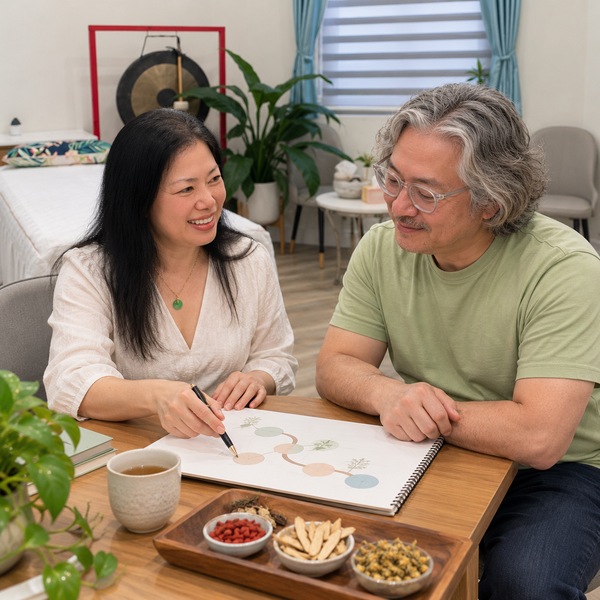
The Lane Cove rooms are at 2 Austin Street, directly opposite the Lane Cove Library and a few metres from Longueville Road. If you are coming from the village it is a walk of two or three minutes, and the parking behind the library is the easiest option in the middle of the day.
Lane Cove sends a particular mix of problems through the door. There are the desk-and-commute necks and low backs from St Leonards and the city, the shoulders and elbows of a suburb that plays a lot of tennis, and the knees and Achilles tendons that come with living on a hillside — the stairs down to Tambourine Bay and the streets off Burns Bay Road are their own kind of training load. Lane Cove also has a lot of people in their thirties and forties carrying small children, which is its own demand on a back.
A first appointment is mostly questions and movement testing: where the pain is, what makes it worse, what it stops you doing, and how it has behaved over weeks rather than days. From there you should leave knowing what is proposed, roughly how long it is expected to take, and what would mean changing the plan.
Worth bringing: any imaging or specialist letters you already have, a list of medications, and the shoes you actually walk or train in. If the pain is new and severe, follows a significant fall, or comes with numbness, weakness, fever or any change in bladder or bowel control, see a doctor first — that is a medical assessment, not a treatment question.
The nearest alternative if Lane Cove does not suit you is the Freshwater side, about 14 kilometres away across the Spit.

Gua sha, cupping and instrument-assisted soft tissue mobilisation can appear side by side in articles, yet they involve different actions, frameworks and risks.
If you play sport, see a physiotherapist or spend time in fitness forums, you may have come across gua sha, cupping and IASTM, short for instrument-assisted soft tissue mobilisation, all in the same breath. They can look similar from the outside, since each involves working on the skin and muscles with a tool. Grouping them together, though, can hide real differences.
Each method has its own reasoning, its own risks and its own evidence base. One should not be assumed to share the results or cautions of another simply because they appear in the same article.
When discussing care with Dr Christine Shen, Acupuncturist, at the Freshwater clinic, ask which method she has in mind and what sensations to expect. Mention how much pressure you usually tolerate and how your skin has reacted to similar techniques in the past. If you are also seeing a physiotherapist who uses IASTM, let Christine know so the two approaches do not overlap on the same sore area.
What a tool is called matters less than a plain explanation of what will be done, why it is relevant to your problem and how you can stop if it becomes uncomfortable.
Before treatment, choose a specific activity to discuss later, perhaps running downhill or reaching behind your back. At follow-up, look at that activity, how comfortable the session felt and the state of your skin afterwards. Marks tell only part of the story.
Knowing which method you are receiving makes it easier to judge whether it suits you. Clarity about the procedure turns an assortment of tools into a choice you can actually weigh.
Copyright© 2002-2026 visuallink© SaaS - Web Hosted Solutions, Design and Maintenance by Visual Link IT Pty Ltd - Software Solutions

Please Login or Sign up to be able to comment