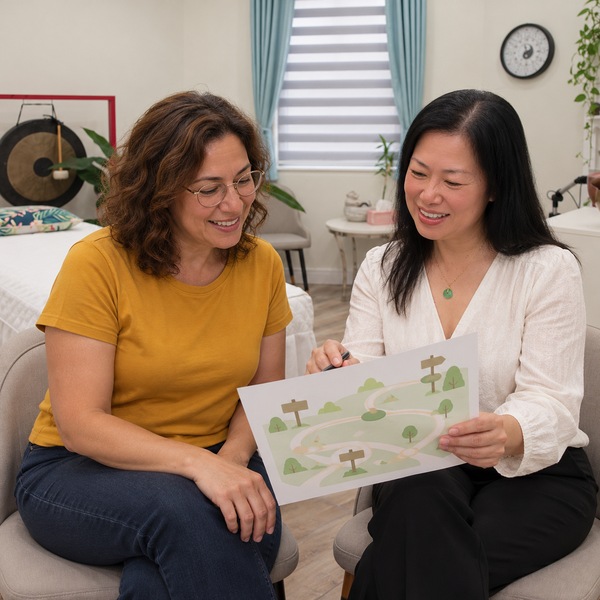
The Lane Cove rooms are at 2 Austin Street, directly opposite the Lane Cove Library and a few metres from Longueville Road. If you are coming from the village it is a walk of two or three minutes, and the parking behind the library is the easiest option in the middle of the day.
Lane Cove sends a particular mix of problems through the door. There are the desk-and-commute necks and low backs from St Leonards and the city, the shoulders and elbows of a suburb that plays a lot of tennis, and the knees and Achilles tendons that come with living on a hillside — the stairs down to Tambourine Bay and the streets off Burns Bay Road are their own kind of training load. Lane Cove also has a lot of people in their thirties and forties carrying small children, which is its own demand on a back.
A first appointment is mostly questions and movement testing: where the pain is, what makes it worse, what it stops you doing, and how it has behaved over weeks rather than days. From there you should leave knowing what is proposed, roughly how long it is expected to take, and what would mean changing the plan.
Worth bringing: any imaging or specialist letters you already have, a list of medications, and the shoes you actually walk or train in. If the pain is new and severe, follows a significant fall, or comes with numbness, weakness, fever or any change in bladder or bowel control, see a doctor first — that is a medical assessment, not a treatment question.
The nearest alternative if Lane Cove does not suit you is the Freshwater side, about 14 kilometres away across the Spit.

Traditional Chinese Medicine (TCM) is one of the oldest systems of medicine in the world that covers a broad range of modalities such as acupuncture, herbal medicine, cupping, Qigong, and Chinese massage or Tuina, among others. It is a holistic approach to disease treatment and prevention that examines the root cause of an imbalance that affects an individual's physical, mental, emotional and spiritual well-being.
A TCM practitioner treats their patient's whole person, which means they take the mind, body, emotions and spirit not as separate parts but as an integrated whole.
For a successful online experience with a TCM practitioner, find a quiet room in your house free from distractions. The flow of your Qi along your energy pathways must be the only thing the practitioner should feel and hear about tracing the root of your health issue.
Next, download the Zoom app onto your computer, test your webcam and audio settings, and search for a qualified TCM practitioner in Australia. Once you've found one, thoroughly review their qualifications; if you like what you see, you may book an appointment with them.
TCM is very popular these days because of its efficacy in treating all kinds of conditions and its affordability. You won't spend more than $100 on a week's Chinese herbs.
During your virtual appointment with a TCM practitioner, the latter will inspect your tongue for any yin and yang disharmony indicators. A pinkish language indicates balance and harmony, while a red tongue has white spots, a yellow coating, cracks or a red tip that could suggest a deficiency in the blood, Qi, yin, yang, or poor circulation.
Each region of the tongue corresponds to a specific organ within the body. For instance, the tongue tip represents the heart. The centre connects to the stomach, and the innermost section to the kidneys. After examining your tongue, the practitioner can explain the underlying cause of your condition and how it can be treated.
Apart from receiving the proper treatment, you will also learn how to take much better care of your health before your online Traditional Chinese Medicine (TCM) consultation ends. Your practitioner will happily recommend food and lifestyle habits promoting wellness and longevity.


